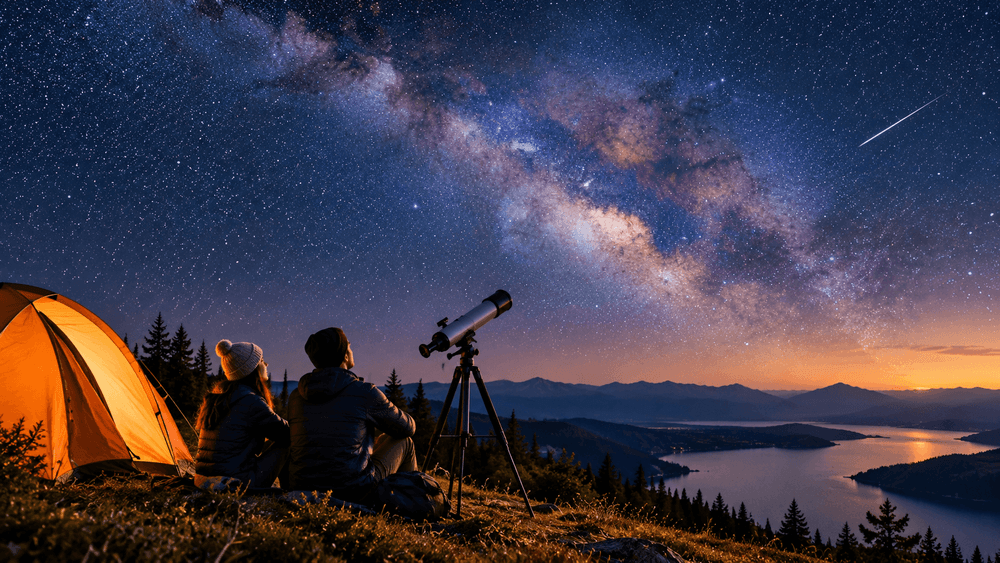
There are places in the world where night feels completely different.
Far from city lights, the sky becomes deeper, darker, and almost impossibly full of stars. The Milky Way stretches across the horizon. Constellations become easier to recognize. On the right night, you may even see a meteor cross the sky before disappearing in a second.
Quick travel note
The guide covers the world's notable dark-sky destinations, practical planning advice, photography tips, responsible stargazing, and ways to combine astronomy with adventure, nature, wellness, and slow travel. For travelers who want a reason to step away from crowded attractions and experience something quieter, astrotourism offers an entirely different way to see the world.
You don't need a luxury resort, a packed sightseeing schedule, or an endless list of attractions to experience something extraordinary.
Sometimes, you simply need to look up.
That simple idea is at the heart of astrotourism — a style of travel built around stargazing, dark skies, astronomy, celestial events, and experiences that allow travelers to connect with the night sky.
And in 2026, astrotourism is becoming an increasingly interesting reason to choose one destination over another.
What Is Astrotourism?
Astrotourism is travel centered around astronomy and the night sky.
It can be as simple as traveling somewhere with exceptionally dark skies to see the Milky Way or as immersive as joining a guided astronomy experience with professional telescopes, astrophotography sessions, observatory visits, or specialized night-sky tours.
The experience doesn't have to be highly technical.
You don't need to know every constellation.
You don't need expensive equipment.
And you certainly don't need to be an astronomer.
For many travelers, astrotourism is simply about experiencing a sky that looks dramatically different from what they see at home.
That is what makes it so accessible.
Why Are Travelers Becoming Interested in Stargazing Trips?
Modern travel often focuses on what we can see during daylight.
Famous landmarks.
Museums.
Beaches.
Restaurants.
National parks.
But once the sun goes down, most travelers return to their accommodation or head into brightly lit towns.
Astrotourism changes that.
The night becomes part of the destination.
Instead of thinking of sunset as the end of the day, travelers begin to see it as the beginning of another experience.
A remote desert can become an observatory.
A mountain lodge can become a front-row seat to the stars.
A quiet island can become the perfect place to watch the Milky Way.
And a winter trip can turn into an opportunity to search the sky for the northern lights.
The Appeal of Dark Skies
The quality of a night sky depends heavily on light pollution.
In large cities, artificial light can make it difficult to see many stars with the naked eye.
Move far enough away from those lights, however, and the difference can be remarkable.
The sky becomes darker.
More stars become visible.
The Milky Way becomes easier to recognize.
And the experience becomes much more immersive.
This is why dark-sky destinations have become increasingly important for travelers interested in astronomy and nature.
Dark skies aren't simply a beautiful backdrop.
For many destinations, protecting them is also part of preserving the natural environment and the character of the landscape.
What Makes a Great Stargazing Destination?
Not every beautiful destination is automatically a good place for stargazing.
Several factors can influence the quality of the experience.
Low Light Pollution
This is perhaps the most important factor.
The farther you are from major sources of artificial light, the more of the night sky you are likely to see.
Remote deserts, mountains, rural areas, islands, and protected natural landscapes can offer excellent conditions.
Clear Skies
Darkness isn't enough.
Cloud cover can completely change the experience.
Destinations with dry climates and relatively clear weather often provide better conditions for observing the night sky.
This is one reason places such as Chile's Atacama Desert have become famous among astronomy enthusiasts.
Low Humidity
Moisture in the atmosphere can affect visibility.
Dry environments tend to provide clearer conditions, which is another reason deserts are particularly attractive for astrotourism.
Elevation
Higher-altitude destinations can sometimes offer excellent observing conditions because there is less atmosphere above you.
Mountain regions can therefore provide spectacular opportunities for stargazing, provided weather and accessibility cooperate.
Accessibility
The darkest sky isn't always the best choice if reaching it requires an extremely complicated journey.
For a successful trip, consider how easily you can reach the destination, where you will stay, and how you will travel after dark.
A beautiful stargazing location becomes much more enjoyable when the entire experience is thoughtfully planned.
Astrotourism Is About More Than Looking at Stars
At first, stargazing may sound like a very simple activity.
Find a dark place.
Look up.
Wait.
But the experience can become much richer when combined with other elements of travel.
Imagine spending the day exploring a desert landscape before watching the Milky Way after sunset.
Or hiking through a national park during the afternoon and joining an astronomy session at night.
Or spending a winter evening in a remote cabin waiting for the aurora.
This is where astrotourism becomes more than astronomy.
It becomes a way of experiencing an entire destination differently.
Stargazing as a Form of Slow Travel
There is also something naturally slow about looking at the night sky.
There is nothing to rush.
The stars don't need to be checked off a list.
You simply sit, wait, observe, and allow the landscape to unfold.
That makes astrotourism a natural companion to the broader slow-travel movement.
Instead of asking:
“How many places can I see today?”
The question becomes:
“How long can I stay here and truly experience it?”
A night spent under a dark sky can be one of the quietest moments of an otherwise busy trip.
And sometimes, that is exactly what travelers are looking for.
The Different Types of Astrotourism Experiences
Astrotourism isn't one single type of vacation.
Travelers can choose experiences based on how deeply they want to engage with astronomy.
Stargazing
The simplest form is simply finding a dark location and spending time under the stars.
No telescope is required.
A blanket, comfortable clothing, patience, and a clear night can be enough.
Guided Astronomy Tours
A local astronomy guide can help identify constellations, planets, stars, and other celestial objects.
These experiences can be particularly useful for beginners because you don't have to figure everything out yourself.
Observatory Visits
Some destinations are home to major observatories that allow visitors to learn about professional astronomy and, in some cases, observe through powerful telescopes.
These visits can add an educational element to a trip.
Astrophotography
For photography enthusiasts, the night sky creates an entirely different creative challenge.
Capturing the Milky Way above mountains, deserts, lakes, or coastlines can produce extraordinary images.
You don't necessarily need the most expensive camera.
Understanding the basics of low-light photography, finding a dark location, and being patient can make a bigger difference.
Meteor Shower Travel
Some travelers plan entire trips around major meteor showers.
Rather than hoping to see a shooting star by chance, they choose a destination with dark skies and travel during a period when meteor activity is expected to be higher.
Aurora Hunting
The northern and southern lights are among the most recognizable celestial experiences in the world.
Travelers may visit northern destinations specifically for the chance to see the aurora dancing across the sky.
Unlike ordinary stargazing, however, aurora sightings depend on several factors, including solar activity, darkness, cloud cover, and location.
That uncertainty is part of the experience.
The Magic of the Milky Way
For many travelers, seeing the Milky Way clearly for the first time is the moment that makes a stargazing trip unforgettable.
In heavily light-polluted cities, the Milky Way can be difficult or impossible to see with the naked eye.
Under a truly dark sky, however, it can appear as a vast band stretching across the night.
The experience can feel almost unreal.
You're looking at the same galaxy you've seen in photographs, but this time you're seeing it directly above you.
That sense of scale is one of the reasons people travel thousands of miles for dark skies.
Why Desert Destinations Are Ideal for Astrotourism
Deserts offer several natural advantages for stargazing.
They are often remote.
They typically have low population density.
Many have very dry climates.
And their landscapes tend to create dramatic foregrounds for the night sky.
The Atacama Desert in Chile is one of the world's most famous examples.
Located far from major urban light sources and known for exceptionally dry conditions, the region has become an important location for astronomical research as well as tourism.
For travelers, the experience goes beyond simply looking at stars.
You're standing in one of the most extraordinary landscapes on Earth while watching the sky above it.
Why Mountains Create a Different Stargazing Experience
Mountains bring another dimension to astrotourism.
At higher elevations, the surrounding landscape can become almost completely silent after dark.
You may see stars above snow-covered peaks, alpine lakes, forests, or remote valleys.
The combination of altitude, darkness, and dramatic scenery can create a powerful visual experience.
Destinations such as New Zealand, the Canadian Rockies, the European Alps, and parts of the Himalayas offer opportunities to combine mountain travel with night-sky experiences.
Astrotourism and Wellness
At first, astronomy and wellness may seem unrelated.
But spend twenty minutes under a dark sky without your phone, notifications, traffic, or city noise, and the connection becomes easier to understand.
Stargazing naturally encourages stillness.
You slow down.
You breathe.
You look outward instead of at a screen.
You don't have to achieve anything.
For travelers interested in wellness, a night-sky experience can therefore become a quiet part of a larger restorative itinerary.
A day of hiking followed by an evening beneath the stars can be just as meaningful as a traditional spa experience.
What to Expect From an Astrotourism Trip
Astrotourism requires something that modern travelers aren't always used to: patience.
You cannot control the weather.
You cannot guarantee that clouds will disappear.
You cannot schedule the Milky Way like a restaurant reservation.
And you can't force yourself to see something simply because you've traveled a long way to find it.
The best approach is to think of stargazing as an experience with an element of uncertainty.
Prepare carefully.
Choose the right location.
Check the forecast.
Understand the moon phase.
Work with local guides when appropriate.
And then give the night a chance to surprise you.
The Best Part May Be the Silence
Perhaps the most underrated element of astrotourism isn't the stars at all.
It's the silence.
Far from city lights, the night can feel remarkably still.
No traffic.
Few screens.
Little noise.
Just darkness, landscape, and the sky above you.
For travelers accustomed to constantly moving, scrolling, checking, and consuming information, that can feel surprisingly powerful.
And perhaps that's why astrotourism fits so naturally into the way travel is evolving.
Sometimes, the most memorable experience isn't another attraction.
It's simply having the opportunity to look up and stay there for a while.
What We'll Explore Next
Astrotourism in 2026: The Ultimate Guide to Traveling for Dark Skies, Stargazing & Celestial Experiences
Best Astrotourism Destinations Around the World
The night sky looks different everywhere.
In some destinations, the Milky Way stretches across a completely dark horizon. In others, the landscape becomes part of the experience, with snow-covered mountains, volcanic terrain, deserts, or remote coastlines creating a dramatic foreground.
The best destination for you depends on what you want to see and how you want to experience it.
Some travelers want pure stargazing.
Others want an observatory experience, an aurora adventure, astrophotography, or a trip that combines astronomy with hiking, wildlife, and culture.
Here are some of the destinations worth considering for an unforgettable astrotourism experience in 2026.
1. Atacama Desert, Chile
The Atacama Desert is one of the world's most iconic destinations for astronomy.
Its combination of extremely dry conditions, high elevation, and limited artificial light creates exceptional opportunities for observing the night sky.
During the day, the landscape itself is extraordinary, with vast salt flats, volcanic mountains, lagoons, and desert valleys.
After sunset, the experience changes completely.
The Milky Way becomes the main attraction.
Visitors can join guided astronomy tours, use professional telescopes, learn about constellations, or simply find a quiet location away from artificial lights.
For travelers who want their entire trip to feel otherworldly, the Atacama offers a rare combination of dramatic daytime landscapes and extraordinary nighttime skies.
2. Aoraki Mackenzie, New Zealand
New Zealand is famous for its mountains, lakes, hiking trails, and dramatic landscapes, but it also has an important place in the world of dark-sky travel.
The Aoraki Mackenzie region on New Zealand's South Island is internationally recognized for its exceptionally dark skies.
The area around Aoraki/Mount Cook combines alpine scenery with opportunities for nighttime astronomy.
During the day, travelers can hike, explore the surrounding landscapes, or visit Lake Tekapo.
At night, the sky becomes the centerpiece.
This makes the region particularly appealing for travelers who don't want to choose between outdoor adventure and stargazing.
3. Namibia
Namibia offers something that few other destinations can match: enormous landscapes with very little artificial light.
The country's remote desert environments create ideal conditions for experiencing the night sky.
Imagine watching the Milky Way rise above sand dunes, rocky landscapes, or an isolated desert lodge.
The experience becomes even more memorable because of the silence.
Namibia is also an excellent choice for travelers who want to combine astrotourism with wildlife and nature.
A safari during the day followed by stargazing at night creates an itinerary where both the landscape and the sky become part of the journey.
4. Iceland
Iceland is one of the world's most popular destinations for travelers hoping to see the Northern Lights.
The country's high latitude, long winter nights, remote landscapes, and relatively low population density make it an attractive destination for aurora hunting.
But the northern lights are not guaranteed.
Cloud cover and solar activity can affect visibility, which means travelers should approach an aurora trip with realistic expectations.
The uncertainty is part of the adventure.
And even when the lights don't appear, Iceland still offers waterfalls, glaciers, volcanic landscapes, black-sand beaches, geothermal pools, and dramatic coastal scenery.
5. Canary Islands, Spain
The Canary Islands offer a combination that makes them particularly interesting for astronomy travelers: relatively mild weather, high-altitude locations, and excellent observing conditions in several areas.
The islands are also home to important astronomical observatories.
Travelers can combine daytime exploration with evening stargazing, making the destination suitable for people who want astronomy to be one part of a broader vacation rather than the entire focus.
Volcanic landscapes add another layer to the experience.
Watching the stars above a volcanic island can make the landscape feel almost surreal.
6. Utah, USA
The American Southwest is filled with dramatic landscapes that become even more impressive after dark.
Utah's national parks and desert regions offer extraordinary combinations of red-rock formations and night skies.
Places around Arches, Canyonlands, Capitol Reef, Bryce Canyon, and Natural Bridges can provide memorable stargazing experiences when conditions are right.
Imagine standing beneath a Milky Way sky while enormous sandstone formations disappear into the darkness around you.
For photographers, the combination of foreground landscapes and stars can be particularly rewarding.
7. Arizona, USA
Arizona is another strong destination for travelers interested in dark skies.
The state's deserts, high plateaus, and remote landscapes offer numerous opportunities to escape artificial light.
Flagstaff and the surrounding region have a long connection with astronomy, while the Grand Canyon provides an unforgettable setting for nighttime observation.
A trip here can easily combine hiking, road trips, national parks, photography, and astronomy.
That makes it particularly attractive to travelers who want a varied itinerary.
8. Australia
Australia offers enormous distances, remote landscapes, and some excellent opportunities for observing the southern night sky.
The country's remote regions can provide exceptionally dark conditions, while destinations such as the Northern Territory and parts of Western Australia offer dramatic natural surroundings.
Australia is also interesting for travelers who want to see celestial objects that are difficult or impossible to observe from northern latitudes.
The Southern Hemisphere sky has its own character.
That alone can make the journey worthwhile for astronomy enthusiasts.
9. Norway
Norway is best known among astrotourism travelers for one spectacular phenomenon: the Northern Lights.
Northern destinations such as Tromsø and the Lofoten Islands attract visitors hoping to see the aurora during the darker months.
But an aurora trip doesn't have to revolve entirely around waiting for the lights.
Travelers can combine the experience with fjord excursions, winter walks, scenic drives, local food, snow activities, and cultural experiences.
The result is a more complete trip, even if the aurora decides not to appear.
10. Ladakh, India
For travelers looking for a high-altitude astrotourism experience, Ladakh offers a remarkable combination of landscape, altitude, remote locations, and relatively low light pollution in many areas.
The region's stark mountains, monasteries, valleys, and high-altitude landscapes create an extraordinary setting for nighttime photography and stargazing.
The night sky can feel particularly dramatic against the barren Himalayan landscape.
However, altitude should be taken seriously.
Travelers should allow time to acclimatize and plan outdoor activities according to local conditions.
11. The Scottish Highlands
The Scottish Highlands offer a very different kind of stargazing experience.
Instead of deserts and dramatic volcanic landscapes, you get mountains, lochs, rugged coastlines, castles, and quiet rural areas.
The combination of dark skies and atmospheric landscapes creates an experience that feels distinctly Scottish.
A stargazing trip here can easily be combined with road trips, hiking, local food, history, and photography.
12. The Canary Islands and Volcanic Landscapes
Volcanic destinations deserve special attention in astrotourism because their landscapes can create extraordinary contrasts against the night sky.
From black volcanic terrain to high mountain viewpoints, these environments offer photographers and stargazers unusual foregrounds.
The experience becomes about more than astronomy.
It's about seeing a familiar landscape transformed after sunset.
Best Destinations for Different Astrotourism Experiences
Choosing a destination becomes easier when you decide what you actually want to see.
Best for Milky Way Viewing
For travelers primarily interested in seeing the Milky Way, look toward destinations with exceptionally dark skies and low light pollution.
Atacama Desert, Namibia, New Zealand, Australia's remote regions, and parts of the American Southwest are particularly appealing.
Best for Northern Lights
If your dream is to see the aurora, consider destinations in the high northern latitudes such as:
Northern Norway, Iceland, Finland, Sweden, Alaska, and parts of Canada.
Remember that aurora viewing is never completely predictable.
Weather, darkness, and solar activity all matter.
Best for Astrophotography
Astrophotographers often look for more than darkness.
They want dramatic foregrounds.
Mountains, deserts, lakes, volcanic landscapes, forests, and coastlines can all create compelling compositions.
Utah, Arizona, Iceland, New Zealand, Namibia, and the Atacama Desert offer particularly striking combinations of landscape and night sky.
Best for Beginners
First-time stargazers don't necessarily need to travel to the most remote location on Earth.
Look for destinations that offer:
- Easy access to dark-sky areas
- Guided astronomy experiences
- Reliable accommodation
- Local astronomy guides
- Equipment rental or telescope experiences
- Other daytime activities
This allows you to make the night-sky experience part of a larger vacation.
Astrotourism Doesn't Have to Be Expensive
One misconception about astronomy travel is that you need expensive equipment or specialized tours.
You don't.
Some of the most memorable stargazing experiences can be completely free once you've reached a dark location.
You can lie beneath the sky and simply watch.
If you want to go deeper, guided tours and observatories can add educational value, but they're not essential.
The biggest investment is often simply choosing the right destination and timing your visit well.
The Importance of the Moon
The Moon can dramatically change a stargazing experience.
A bright full moon can illuminate the landscape and make some faint stars less visible.
A darker moon phase can create better conditions for seeing faint celestial objects and the Milky Way.
But that doesn't mean a full moon is always bad.
Moonlight can create beautiful landscape photography and make nighttime hiking or sightseeing feel completely different.
The best moon phase depends on what you want from your trip.
Plan Around the Experience, Not Just the Destination
Instead of simply asking:
“Where should I go?”
Ask:
“What do I want to see?”
Do you want the Milky Way?
The northern lights?
A meteor shower?
The moon?
A particular constellation?
Astrophotography?
Once you know the answer, destination selection becomes much easier.
You can then research the best season, moon phase, weather conditions, local accessibility, and available guided experiences.
Combining Stargazing With Daytime Adventures
One of the best things about astrotourism is that it doesn't have to dominate your entire itinerary.
In fact, it often works better when combined with other experiences.
A typical day might look something like this:
Morning: Hiking or wildlife watching
Afternoon: Local food, cultural exploration, or relaxation
Sunset: Scenic viewpoint
Evening: Dinner
Night: Stargazing or astronomy experience
This rhythm gives the trip variety without making every hour feel scheduled.
A Different Kind of Luxury
Luxury travel is often associated with five-star hotels, private transfers, and exceptional dining.
But there is another form of luxury that is becoming increasingly valuable: access to experiences that are difficult to find in everyday life.
A completely dark sky.
A silent desert.
A private viewpoint overlooking a mountain range.
A night where the Milky Way is visible from horizon to horizon.
These experiences can't simply be purchased in a city.
They require travel.
And for many travelers, that makes them more meaningful than another conventional luxury amenity.
What to Expect When Stargazing
Your first serious stargazing experience may be different from what you expect.
Your eyes need time to adjust to darkness.
It can take around 20 to 30 minutes for night vision to become significantly better, so constantly looking at your phone can reduce the experience.
You may also notice that the sky isn't always immediately spectacular.
Give yourself time.
Look for familiar patterns.
Let your eyes adjust.
Listen to your guide.
And resist the temptation to photograph everything immediately.
Sometimes the best way to experience the night sky is simply to stand there and watch it.
The Future of Astrotourism
Astrotourism sits at an interesting intersection of several travel trends.
It combines nature, slow travel, wellness, photography, adventure, science, and meaningful experiences.
It also encourages travelers to visit remote areas and stay longer rather than rushing through multiple destinations.
For some travelers, the appeal is scientific.
For others, it's visual.
For others, it's simply the feeling of standing beneath a sky that seems much larger than the one they know at home.
Whatever the reason, astrotourism offers something increasingly rare in modern travel:
a reason to slow down and look up.
What We'll Explore Next
Astrotourism in 2026: The Ultimate Guide to Traveling for Dark Skies, Stargazing & Celestial Experiences
How to Plan an Astrotourism Vacation
A great stargazing trip doesn't happen entirely by accident.
While there will always be an element of uncertainty, a little planning can dramatically improve your chances of experiencing a spectacular night sky.
The first step is deciding what you actually want to see.
Are you hoping to photograph the Milky Way? Do you want to see the northern lights? Are you interested in meteor showers? Or do you simply want to spend an evening somewhere with almost no artificial light?
Once you know your goal, you can choose the destination, season, accommodation, and activities around it.
Choose the Right Time of Year
Timing matters enormously in astrotourism.
Different celestial experiences are visible at different times of the year, while weather and daylight hours can also change significantly from season to season.
For example, travelers searching for the northern lights generally need to visit during periods with sufficiently dark nights and favorable conditions.
If your goal is Milky Way photography, you'll want to consider the visibility of the galactic core, moonlight, and local weather.
Meteor showers also occur during specific periods.
Before booking flights, check the astronomical calendar for the experience you're hoping to see.
The destination may be beautiful all year, but the night sky experience you want may not be.
Check the Moon Phase
The Moon can completely change the appearance of a night sky.
A bright moon can wash out faint stars and make the Milky Way less visible.
A darker moon phase can create much better conditions for observing faint stars and deep-sky objects.
However, don't assume that a dark moon is automatically the best time to visit.
A bright moon can illuminate mountains, deserts, lakes, and other landscapes beautifully, particularly for photography.
The right moon phase depends on your priorities.
Look for Dark-Sky Locations
When researching your destination, don't simply search for “best places to stargaze.”
Look for areas away from major cities and sources of artificial light.
Protected natural areas, remote deserts, rural regions, mountains, and designated dark-sky locations can offer significantly better conditions.
If possible, check a current light-pollution map before finalizing your location.
A destination that looks remote on a regular map may still have significant light pollution nearby.
Give Your Eyes Time to Adjust
One of the simplest mistakes first-time stargazers make is expecting to see everything immediately.
Human eyes need time to adapt to darkness.
Once you arrive at your viewing location, avoid bright lights and give yourself time to adjust.
This also means being careful with your phone.
Even a quick look at a bright screen can interfere with your night vision.
If you need to use your phone, lower the brightness as much as possible or use a red-light setting.
What to Pack for Stargazing
You don't need complicated equipment to enjoy an astrotourism trip.
Start with the basics.
Warm layers: Even destinations that feel warm during the day can become surprisingly cold after sunset.
Comfortable shoes: You may need to walk across uneven terrain or natural surfaces.
Headlamp or flashlight: A red-light mode is particularly useful because it helps preserve night vision.
Water: Remote stargazing locations may have limited facilities.
Portable power bank: Useful for phones, cameras, and navigation equipment.
Blanket or lightweight chair: Sitting comfortably can make a long stargazing session much more enjoyable.
Camera and tripod: Essential if you want to experiment with astrophotography.
Binoculars: A simple pair can reveal much more detail in the night sky.
You don't need to buy a professional telescope.
For most beginners, simply finding a dark location and spending time there is enough.
Astrophotography for Beginners
Taking photographs of the night sky can seem intimidating.
But modern cameras and smartphones have made it considerably more accessible.
If you're using a camera, a tripod is one of the most useful pieces of equipment because long exposures require the camera to remain completely still.
A wide-angle lens is useful for capturing both the sky and the surrounding landscape.
You can then experiment with longer exposures, higher ISO settings, and manual focus.
Don't expect your first photograph to look like a professional observatory image.
The goal isn't perfection.
It's learning how to capture something you experienced yourself.
And sometimes, the photograph you take isn't as impressive as the memory of standing beneath the sky in the first place.
How to Photograph the Milky Way
If you're specifically interested in photographing the Milky Way, preparation becomes even more important.
Find a location with minimal light pollution.
Choose a night when the moon won't overpower the sky.
Use a sturdy tripod.
Focus manually on a distant star or bright object.
Shoot several test images and adjust your settings gradually.
Most importantly, don't spend the entire night looking at your camera screen.
Take your photographs.
Then put the camera down.
The reason you traveled thousands of miles was to experience the sky, not just photograph it.
Planning a Northern Lights Trip
Aurora travel requires a slightly different approach from ordinary stargazing.
The northern lights are influenced by solar activity, but even strong aurora activity doesn't guarantee that you will see them from your specific location.
Cloud cover, darkness, visibility, and local weather all matter.
This is why experienced travelers often stay for several nights rather than planning a single evening around the aurora.
A longer stay gives you more opportunities.
And it also reduces the pressure on any one night.
Choose accommodation that gives you reasonable access to dark areas and consider joining a local aurora tour if you're unfamiliar with the destination.
Local guides can monitor conditions and move to locations with better visibility.
Should You Book an Astronomy Tour?
It depends on what you want from the experience.
If you're comfortable finding a dark location and simply looking at the stars, you may not need a guide.
But a guided experience can add considerable value for beginners.
A good astronomy guide can explain what you're seeing, identify constellations, point out planets, provide telescopes, and explain the science behind celestial events.
The experience can become both educational and memorable.
For travelers who aren't familiar with astronomy, a guided tour can turn a beautiful sky into a much more meaningful experience.
Astrotourism With Children
Stargazing can be surprisingly engaging for children.
The key is to make it interactive.
Instead of simply telling them to “look at the stars,” give them something to search for.
Try finding recognizable constellations.
Tell stories about mythology associated with different stars.
Use a simple astronomy app during the daytime to learn what might be visible that night.
Bring warm clothing, snacks, and comfortable seating.
And keep the first experience relatively short.
Children don't need to spend three hours outside to develop an interest in astronomy.
Sometimes seeing one bright planet or a shooting star is enough to make them curious.
Responsible Astrotourism
Dark-sky destinations are often found in fragile natural environments.
That means responsible travel matters.
Stay on designated paths.
Avoid disturbing wildlife.
Don't leave food or trash behind.
Keep artificial lighting to a minimum.
Respect local communities.
Follow rules in protected areas.
And avoid driving into sensitive landscapes simply to find a better photograph.
If you're visiting a designated dark-sky area, follow the guidance provided by local authorities or park managers.
The night sky is a shared natural resource.
Protecting it benefits both travelers and the communities that depend on these landscapes.
How to Reduce Light Pollution While Traveling
Even small actions can help.
Use red lights instead of bright white flashlights when possible.
Turn off unnecessary exterior lights at your accommodation.
Avoid shining powerful lights toward the sky.
If you're staying in a remote lodge, ask whether outdoor lighting can be minimized during designated stargazing periods.
These choices may seem insignificant, but collectively they can help preserve dark skies.
How Long Should an Astrotourism Trip Be?
You don't necessarily need a two-week astronomy expedition.
A 3- to 5-night stay can be enough for a dedicated stargazing experience, particularly if the destination is easy to access.
For aurora trips, staying longer can improve your chances of experiencing favorable conditions.
For a broader vacation, consider making astrotourism one component of a 7- to 10-day itinerary.
For example, you might spend several days exploring a national park or cultural destination and reserve multiple evenings for stargazing.
This approach keeps the trip varied.
A Sample Astrotourism Itinerary
Here's one way to structure a week-long trip:
Day 1: Arrival and relaxed evening
Day 2: Explore the surrounding landscape
Day 3: Nature or cultural experience
Day 4: Guided astronomy experience
Day 5: Slow day with photography or local exploration
Day 6: Second stargazing opportunity
Day 7: Departure
The important part is having more than one opportunity to experience the sky.
Weather doesn't always cooperate.
Giving yourself multiple nights creates flexibility.
Best Astrotourism Experiences for Different Travelers
For Couples
Choose a destination where stargazing can be combined with beautiful accommodation, scenic landscapes, and memorable dining.
A private stargazing experience can make an especially memorable evening.
For Solo Travelers
Guided astronomy tours and small-group experiences can provide an easy way to meet people while learning something new.
For Photographers
Prioritize dark skies, dramatic foreground landscapes, accessibility, and multiple clear nights.
For Families
Choose destinations with easy access, educational astronomy programs, comfortable accommodation, and activities during the daytime.
For Wellness Travelers
Look for destinations where stargazing can be combined with nature, hiking, yoga, spa experiences, and quiet surroundings.
Final Thoughts: Sometimes the Best View Is Above You
Travel has always been about seeing something new.
A new city.
A new coastline.
A new mountain.
A new culture.
But astrotourism offers a different perspective.
It asks you to stop looking at the road ahead and look upward.
You may travel to a remote desert and discover that the most unforgettable part of the journey begins after sunset.
You may hike through mountains during the day and spend the evening watching stars appear above the peaks.
You may travel to the Arctic hoping for the northern lights and discover that even an ordinary clear night feels extraordinary.
And you may return home with fewer photographs than expected but a memory that stays with you for years.
That's what makes astrotourism so compelling.
It isn't simply about astronomy.
It's about wonder, patience, nature, and perspective.
In a world where travel can sometimes feel rushed and over-planned, there is something refreshing about an experience that asks you to do almost nothing.
Just find a dark place.
Sit down.
Look up.
And wait.